

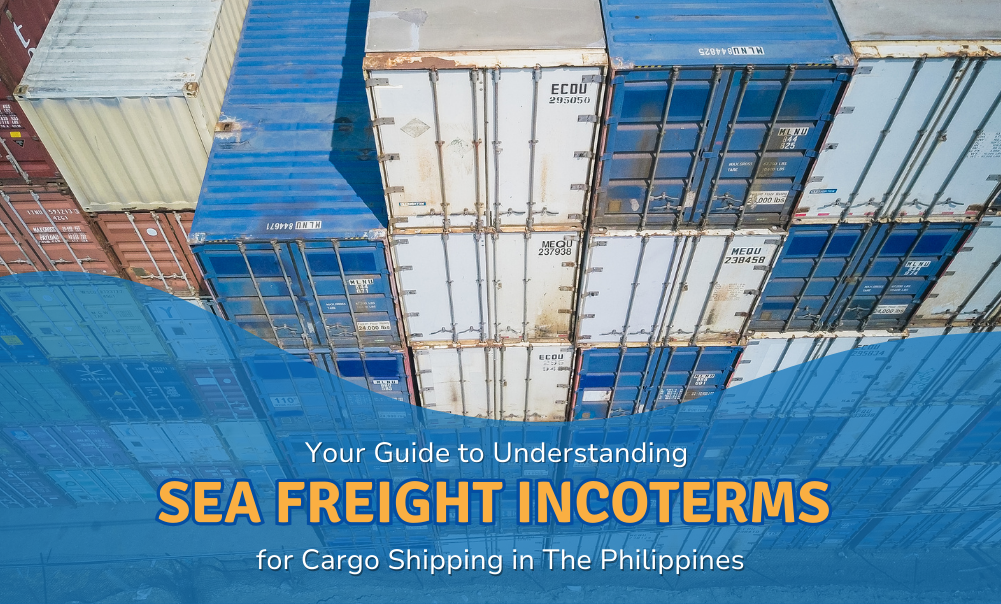
Are you a business owner who wishes to source or send items internationally through sea cargo shipment? You can simplify the contract negotiation for your business transaction, by familiarizing yourself with the different Incoterms.
Incoterms are three-letter terms used to determine the financial responsibilities of each party involved.
These can be tricky if you are new to the shipping industry. Read this practical guide to understanding Incoterms for sea shipment to make your cargo shipping experience smooth.
The Essential Guide to Sea Freight Incoterms
What are Incoterms?
The International Chamber of Commerce (ICC) first published Incoterms in 1936 for the world to use. Incoterms are short for ‘international commercial terms’, which are used to determine the obligations of a buyer and seller in international shipping contracts. In other words, this defines who pays for the cost of certain stages of the shipment and logistics process.
Incoterms are regularly updated by the ICC. The latest revision was published in 2020, and is used in sea freight shipping worldwide. Contracts should explicitly state which Incoterms version they are using, but it is encouraged to use the most recent version.
There are 11 terms mandated by the ICC for international shipping, but these are divided in two: (a) any mode of shipment and (b) sea and inland waterway. This article only discusses sea and inland waterway Incoterms.
Purpose of Incoterms
- Defines the responsibilities of buyers and sellers: As mentioned earlier, Incoterms outline the transfer of risk from the seller to the buyer during the shipment process.
- Helps negotiate your terms with a trading partner: Businesses are bound by local laws, therefore requiring room for negotiation with the other party. Incoterms lay out and help define the terms to be followed in a trade contract.
- Useful in determining costs of buyer and seller: Buyers and sellers can choose which Incoterm structure best suits their logistics needs. Sea transport terms in particular helps reduce costs on either party’s end by adhering to the recommended Incoterm.
4 Incoterms Used for Sea and Inland Waterway Cargo Shipping
-
Free Alongside Ship (FAS)
The seller must transport the goods from the warehouse to the loading dock of the port. They will shoulder the costs of delivery to the port, export duty, taxes, clearance, and handling in the port of origin.
Before the goods are loaded, the risk is immediately transferred to the buyer. The buyer is now responsible for the costs of loading at the origin, delivery to destination, as well as subsequent charges such as unloading and customs clearance.
This Incoterm is best applied to bulk cargo and non-containerized goods.
-
Free On Board (FOB)
This is a popular choice among business owners, FOB divides the responsibilities evenly between the seller and buyer. Here, the seller is responsible for packaging and delivery of goods to the port of origin. Costs from this stage until loading goods on board are charged to the seller.
Meanwhile, the buyer’s obligations only begin once the goods are on board. They are obligated to handle freight charges and subsequent costs until the goods reach the buyer.
FOB is ideal for parties who wish to have equal obligations between each other. This Incoterm is also flexible, allowing more control over costs and planning. Do note, however, that FOB is not applicable to containerized shipments, which should follow Free Carrier (FCA) or Carriage & Insurance Paid (CIP). The two Incoterms fall under any mode of transport and are not specific to sea and inland waterway. Failing to follow the correct term may lead to costly repercussions, confusions between parties, and delays in shipment.
-
Cost and Freight (CFR)
The seller’s responsibilities are the same as with FOB, however, they are now expected to pay the freight costs from origin to destination port.
Risk is transferred to the buyer once the goods are loaded, but because the seller already paid the freight charges, the buyer is only left with the following costs at the destination port: handling, unloading, import duty, taxes, and customs clearance.
This sea freight incoterm is applicable to goods that do not require containerizing, and is recommended for sellers who can directly access loading facilities for vessels.
-
Cost, Insurance, Freight (CIF)
CIF is similar to CFR, however, the seller is obligated to pay insurance costs for the goods. This ensures the safety of goods during transit. Risk is transferred to the buyer once goods are loaded onto the vessel, and they are expected to shoulder subsequent costs upon arrival at the destination.
CIF is preferred by small businesses that are new to international trade. Aside from the insurance coverage that assures the safety and security of the items, this type of Incoterm simplifies complex steps in the sea shipment process to prevent confusion.
One drawback is that CIF is not allowed in case of transport involving another mode than sea. For multimodal shipments, it is best to use Carriage & Insurance Paid (CIP) instead.
What do Incoterms not cover?
While crucial for sea freight shipment, Incoterms do not fully encompass an entire contract. It only determines the duties of the seller and buyer. The following items are not covered by Incoterms and therefore must be stipulated in the sales and shipment contract:
- Locations of port
- Cost of goods
- Payment method
- Regulation regarding transfer of ownership of goods
- Arrangements in case of a breach of contract
- Binding local laws either party must adhere to
Business owners shipping to the Philippines must properly document each step of the sea shipment process, and have all paperwork readily available to prevent any interruptions. Be consistent in using your chosen Incoterm as well to avoid disagreements and miscommunication.
ALSO READ: 5 Ways to Lower the Cost of Cargo Shipping in the Philippines
The use of Incoterms can significantly impact the expansion of your business in the Philippines. Knowledge of sea freight shipping will help you build a good foundation with transportation and logistics partners. Look no further for a reliable partner than Starlite Ferries! Check out our express cargo rates and drop us a message today to avail of our services.